Rice farmers across South Asia frequently struggle with bacterial diseases that severely reduce crop productivity. Among them, Bacterial Leaf Blight (BLB) and Bacterial Leaf Streak (BLS) remain the two most destructive diseases affecting rice cultivation.
For agriculture and veterinary science students, understanding these diseases is essential for exams, practical fieldwork, and professional crop advisory roles. This guide explains the symptoms, favorable conditions, spread, and management practices in a simple and highly readable way.
Understanding Bacterial Leaf Blight (BLB)
Bacterial Leaf Blight is caused by Xanthomonas oryzae pv. oryzae and is considered one of the most damaging bacterial diseases of rice. It affects both seedlings and mature plants, causing early wilting or leaf blighting depending on the stage.
BLB appears in two phases. a) kresek phase: during the seedling stage and b) leaf blight phase: in older plants.
The Kresek Phase (Wilting Stage)
Kresek usually appears between 3–4 weeks after transplanting. Seedlings begin to roll, turn yellow, and eventually dry out. In severe cases, entire clumps of seedlings wilt and die.
Students often confuse kresek with early stem borer damage, but BLB can be confirmed using a simple test.
When the lower portion of an infected seedling is squeezed, a yellowish bacterial ooze emerges. Unlike stem borer damage, infected seedlings are not pulled out easily from the soil.
The Leaf Blight Phase
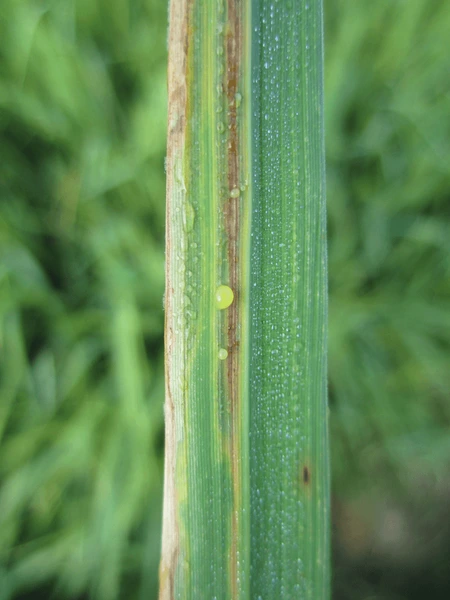
In older plants, BLB begins as water-soaked, yellow-orange streaks on the leaf blade or leaf tip. These lesions have wavy margins and gradually progress toward the leaf base.
Early lesions often produce a bacterial ooze that looks like morning dew. As the disease progresses, the ooze dries into yellow to black beads, which is a characteristic symptom of BLB.
Favorable Conditions for BLB Development
BLB spreads rapidly under the following conditions:
- Temperature between 25–34°C
- Relative humidity above 70%
- Heavy nitrogen fertilization
- Frequent rains and standing water
These conditions promote bacterial multiplication and movement through plant wounds or natural openings.
Survival and Spread of BLB
The bacteria survive in seeds, straw, stubbles, wild rice, Cyperus rotundus, and Panicum repens.
Secondary spread occurs through bacterial ooze, which is carried by rain splash, irrigation water, and insects like grasshoppers and leafhoppers. These insects spread the disease externally, not internally.
Management Strategies for Bacterial Leaf Blight
Managing BLB requires a combination of clean seed, resistant varieties, and timely field interventions. The most effective measures include:
- Using seeds from uninfected fields
- Seed soaking in Agrimycin (0.025%) for 8 hours, followed by hot water treatment at 52–54°C for 10 minutes
- Growing resistant varieties such as IR 20, IR 26, and Pokhreli Masino
- Foliar sprays of Agrimycin (250 ppm) + Copper oxychloride (0.05%) at 12-day intervals
- Promising biological control through Fluorescent pseudomonads
Bacterial Leaf Streak (BLS): Another Emerging Threat
Bacterial Leaf Streak, caused by Xanthomonas oryzae pv. oryzicola, appears during very wet seasons and in fields with high nitrogen application. Unlike BLB, BLS affects only the parenchymatous tissue and does not become systemic throughout the plant.
Recognizing Bacterial Leaf Streak Symptoms
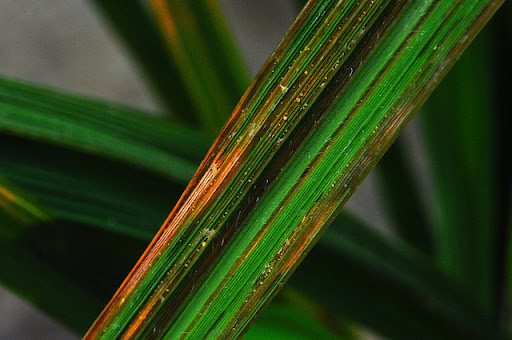
BLS begins with narrow, dark-green, water-soaked streaks running between veins. These streaks vary in length and gradually turn yellow-orange or brown, depending on the rice variety. As the disease progresses, lesions merge and cover large leaf areas.
Students often confuse BLS with the Narrow Brown Spot disease. However:
- BLS lesions are thinner
- They appear translucent
- They may produce bacterial ooze
- Narrow brown spot lesions do not ooze and are not translucent
Favorable Conditions for BLS
Like BLB, BLS thrives under:
- Temperature: 25–34°C
- Relative humidity: Above 70%
- High nitrogen fertilizer application
- Prolonged wetness and rainfall
How BLS Survives and Spreads
The bacteria survive in infested seeds and infected stubbles. Spread occurs mainly through rainwater and insects that carry infected leaf pieces.
Management of Bacterial Leaf Streak
Effective control measures include:
- Planting resistant varieties
- Treating seeds with Streptocycline (250 ppm) followed by hot water treatment at 52°C for 30 minutes
- Spraying Streptocycline (250 ppm) along with Copper oxychloride (0.3%) during the early stages
Why Understanding Bacterial Diseases Matters
For agriculture and livestock science students, bacterial diseases offer strong insights into plant pathology, diagnostic techniques, and integrated pest management (IPM). Knowledge of these diseases also helps future field officers, plant doctors, and extension workers guide farmers effectively.
Conclusion: Strengthening Your Plant Pathology Foundation
Bacterial diseases like BLB and BLS continue to threaten rice production across Asia. With accurate diagnosis, seed health management, resistant varieties, and informed field practices, these diseases can be significantly minimized.
If you want to master plant pathology and improve your exam performance, explore more research-based content at Pedigogy.com, Nepal’s growing platform for agriculture and veterinary resources. You can find the full course here: Visit our Plant Pathology section here.
Updated on November 19, 2025