Understanding the fine structure of gene is essential for BSc Agriculture and Veterinary students, especially in the 3rd semester when classical and molecular genetics are introduced in depth.
Many students memorize definitions but fail to understand what the gene fine structure actually represents at the molecular level. This concept changed the way scientists viewed genes—from indivisible units to complex, divisible functional structures.
In this article, we will clearly explain the fine structure of gene, including Benzer’s contribution, and why it is important for exams and research.
Introduction to the Concept of Gene Structure
Earlier, genes were considered indivisible units controlling a specific trait. This classical concept assumed that a gene could not be broken further by mutation or recombination.
However, advances in molecular genetics proved that genes have an internal structure. This shift led to the development of the concept of gene fine structure.
If you are studying genetics basics, you may also want to review our detailed guide on classical gene concepts available on Pedigogy.
What Is the Fine Structure of Gene?
The fine structure of gene refers to the detailed internal organization of a gene at the molecular level.
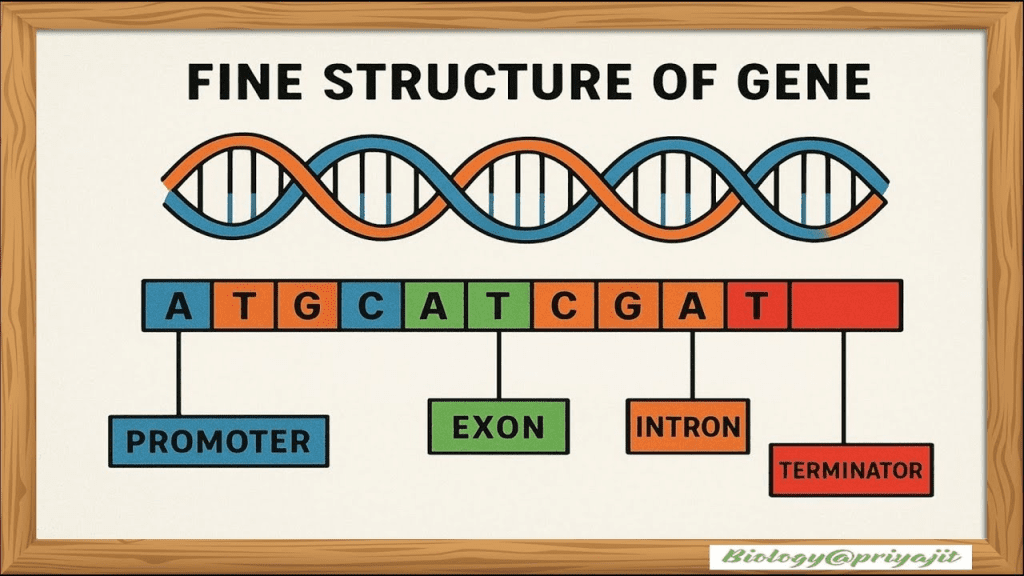
It shows that a gene is not a single indivisible unit. Instead, it consists of multiple smaller units that can undergo mutation and recombination.
In simple terms, gene fine structure explains how genetic material is arranged within a gene and how different functional units operate inside it.
For BSc 3rd semester students, this concept forms the foundation of molecular genetics and biotechnology.
Benzer’s Experiment and Fine Structure of gene
The fine structure analysis of genes became clear through the work of Seymour Benzer.
Benzer conducted experiments on bacteriophage T4 and demonstrated that recombination can occur within a single gene. This proved that genes are divisible and contain smaller functional units.
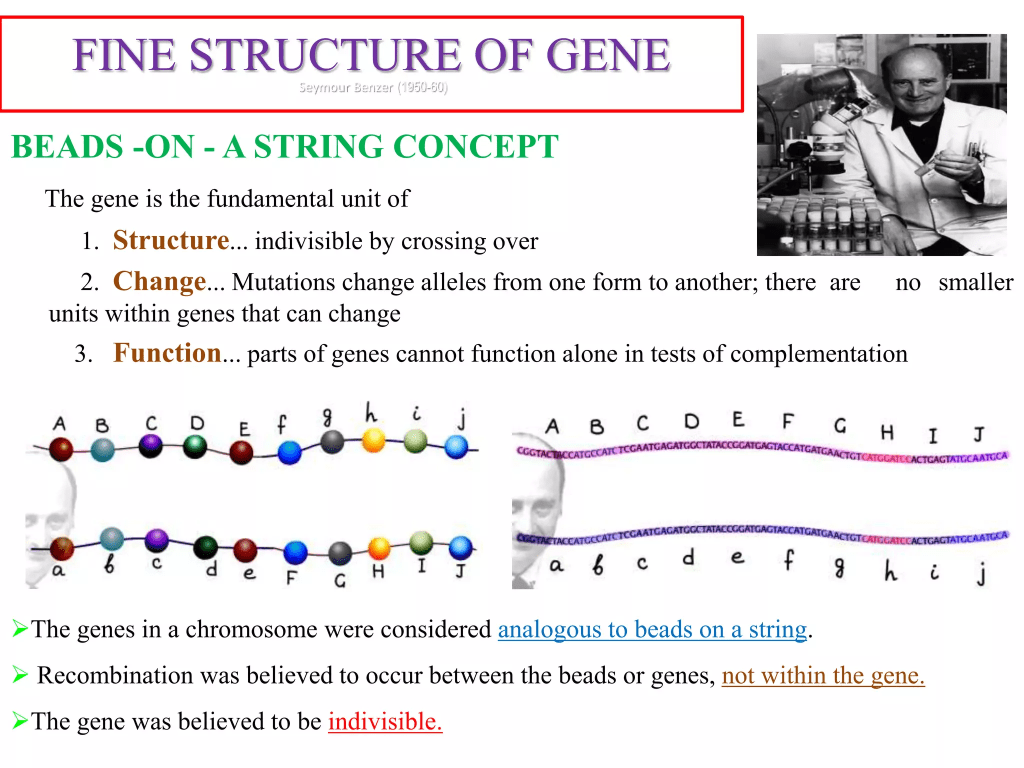
His research laid the foundation for modern genetic fine structure studies.
Cistron
A cistron is the functional unit of a gene.
It represents a segment of DNA that codes for a specific polypeptide chain. In modern terminology, a cistron is equivalent to a gene in functional terms.
Recon
A recon is the smallest unit within a gene that can undergo recombination.
Benzer showed that recombination could occur between adjacent nucleotides, proving that recombination units are extremely small.
Muton
A muton is the smallest unit of mutation.
It corresponds to a single nucleotide pair. This discovery clarified that even a tiny change in DNA sequence can result in mutation.
Fine Structure Analysis of Genes
Fine structure analysis of genes involves studying mutation sites and recombination frequencies within a gene.
This approach helps researchers determine gene mapping at a very detailed level. It also assists in understanding inherited disorders, crop improvement, and disease resistance mechanisms.
For agriculture students, understanding gene fine structure is crucial in plant breeding and biotechnology applications.
You can explore more molecular-level topics in our detailed molecular biology section on Pedigogy.
For broader understanding of genetics in agriculture and food systems, refer to the genetics resources provided by the Food and Agriculture Organization.
Importance for BSc 3rd Semester and Competitive Exams
The question “Explain the fine structure of gene” frequently appears in BSc 3rd semester exams.
Students are often asked to describe Benzer’s experiment and define cistron, recon, and muton with proper explanation.
This topic is also important for MSc entrance exams, PSC, and research-based interviews.
Understanding genetic fine structure strengthens your conceptual clarity in molecular genetics and biotechnology.
Conclusion
The fine structure of gene revolutionized classical genetics by proving that genes are divisible and internally organized.
Through Benzer’s experiment, the units cistron, recon, and muton were identified, providing a detailed understanding of gene organization.
For BSc Agriculture and Veterinary students, mastering this topic ensures strong exam performance and builds a foundation for advanced genetics. Students who want complete exam-oriented notes, diagrams, MCQs, and structured explanations can access the full Genetics module inside our premium course on Pedigogy.
Updated on 18 February 2026