The Modern Theory of Rent provides a more practical understanding of rent than Ricardo’s classical view. Unlike the Ricardian Theory, which explains rent as a surplus from land’s fertility, the modern theory defines rent as the difference between actual earnings and transfer earnings of any factor of production. It applies not only to land but also to other productive resources like labor, capital, and organization.
Definition of Modern Theory of Rent
According to the modern theory, rent = actual earnings – transfer earnings.
Transfer earning refers to the income that a factor of production could earn in its next best alternative use, also known as opportunity cost.
For example, if a hectare of land used for cotton cultivation earns Rs. 15,000 but could earn Rs. 12,000 under paddy cultivation, its rent is Rs. 3,000 (Rs. 15,000 – Rs. 12,000).
This means rent arises due to the difference in earnings between the current use and the next best use of a factor.
Core Idea of the Modern Theory of Rent
According to modern economists, rent arises whenever the supply of a factor is less than perfectly elastic. The concept can be better understood by analyzing three possible cases of supply elasticity.
1. Perfectly Inelastic Supply of Land
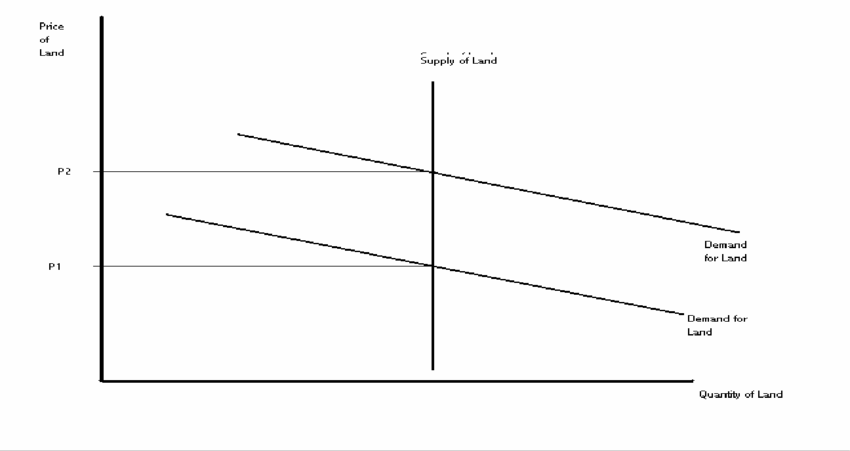
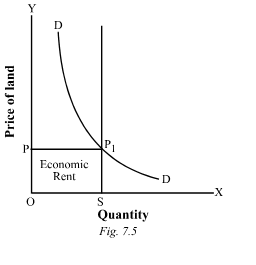
When the supply of land is perfectly inelastic, it means that no matter what the rent or price is, the total quantity of land remains the same.
- The supply curve is a vertical line, indicating a fixed supply.
- The demand for land is a derived demand, based on the demand for products produced on the land.
- As population grows, the demand for food and land increases, which leads to a rise in rent.
Since land cannot be transferred to any other use, its transfer earnings are zero. Thus, the entire income from land is rent.
2. Perfectly Elastic Supply of Land
In this case, the supply of land is perfectly elastic, shown as a horizontal supply curve.
- The factor can be easily transferred from one use to another.
- The actual earnings equal transfer earnings, so no surplus or rent arises.
- In real-world conditions, however, no factor of production has a perfectly elastic supply.
3. Relatively Elastic Supply of Land
Most real-world situations fall between the two extremes. The supply of land is relatively elastic, meaning it can adjust to some extent but not perfectly.
- A portion of income represents rent (surplus over transfer earnings).
- The rest represents transfer earnings (the minimum required to keep the factor in its current use).
Here, the shaded area SRP in the graph represents rent, showing that part of land’s earnings are due to its unique advantage over alternative uses.
Comparison with Ricardian Theory of Rent
| Aspect | Ricardian Theory | Modern Theory |
|---|---|---|
| Basis | Fertility difference in land | Difference between actual and transfer earnings |
| Scope | Land only | All factors of production |
| Emphasis | Natural differences | Opportunity cost |
| Applicability | Classical | Modern and realistic |
Conclusion
The Modern Theory of Rent broadens our understanding of how income is earned from productive resources. It emphasizes that rent is not limited to land but applies to any factor whose supply is less than perfectly elastic. By linking rent to opportunity cost, this theory offers a flexible and realistic approach to analyzing income distribution in modern economics.
Explore more economics concepts on Pedigogy.com, Nepal’s leading platform for research-based education in agriculture and veterinary sciences. Visit our Economics section here.
Updated on 12 November 2025