Transmission of excitatory state from nerve to effector tissue
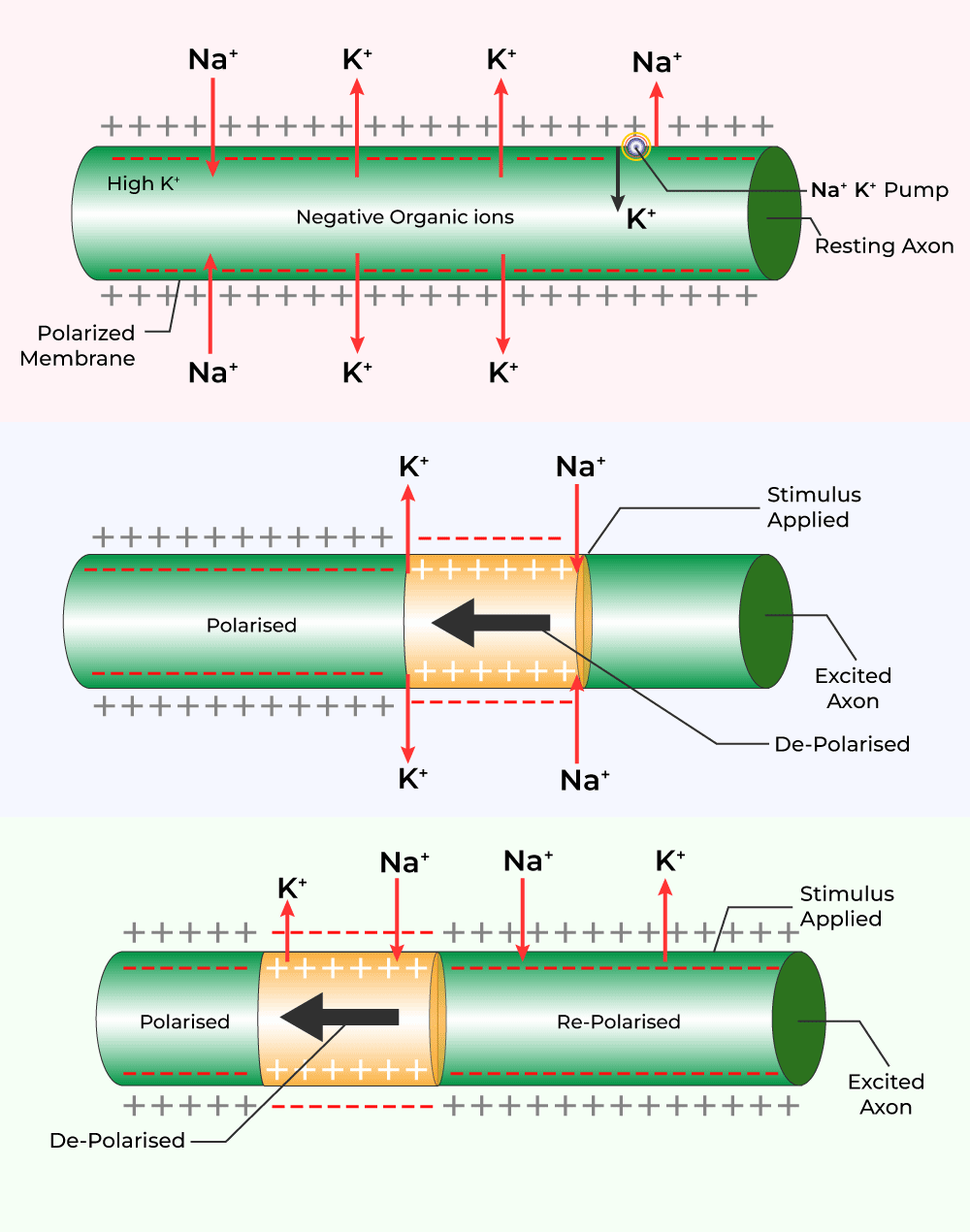
• Nerve impulse conduction is electrochemical governed by differential permeability of axolemma to sodium and potassium ion.
• Nerve impulse activate when chemical stimulus is received by neuron.
Nerve impulse is transmitted in following process:
1. Polarization
• During resting stage, axon membrane is more permeable to K+ than Na+. Similarly, Na+ actively transmitted to ECF. This is sodium pump.
• Sodium ion expellation to ECF is higher than potassium ion inward flow. Thus there is membrane potential
• The potential difference across the membrane during resting stage of nerve fibre is called Resting potential.
2. Depolarization
• When stimulus of threshold potential is applied to nerve fibre, axolemma become more permeable to sodium. So, high number of sodium ion diffuses into axoplasm from extracellular fluid (ECF).
• Now, polarity is reversed to polarization.
• This potential difference which is created by stimulus on nerve fibre is called Action potential.
• At peak of depolarization, axon membrane become permeable to K+ only so it diffuse to ECF from axoplasm. This is repolarization.
• In this way, polarized areas become depolarized and depolarized become repolarized and nerve impulse propagates to effector tissues.
Nerve fibres are mylinated and non mylinated.
• In myelinated nerve fibre, myelin sheath is interrupt at places called node of ranvier.
• In non myelinated nerve fibre, nerve impulse propagates by forming electric wave on nerve fibre.
• Rapid conduction of nerve fibre occurs in myelinated nerve fibre because nerve impulse travels in jumping manner from one node to another. This is called saltatory mechanism.